Quilting for Mental Health: A Therapist’s Insight
In my fifteen years of clinical practice, I’ve witnessed countless patients discover unexpected pathways to emotional healing. Among the most profound transformations I’ve observed come not from traditional talk therapy alone, but from creative pursuits that engage both mind and hands. Quilting, an ancient craft that combines precision with creativity, has emerged as one of the most powerful therapeutic tools I recommend to clients seeking sustainable mental wellness.
When a patient tells me “quilting is my therapy,” I recognize they’ve discovered something neuroscience increasingly validates: the act of creating something meaningful with your hands activates healing mechanisms in the brain that conversation alone cannot reach. This article explores the therapeutic dimensions of quilting through both clinical research and real-world patient experiences, offering insights into why this textile art form has become integral to my mental health treatment recommendations.
The Neuroscience Behind Quilting and Mental Wellness
The therapeutic benefits of quilting extend far beyond the enjoyment of creating something beautiful. When we engage in repetitive, purposeful hand movements—such as cutting fabric, piecing patterns, and hand-stitching—we activate multiple regions of the brain simultaneously. Research from the American Psychological Association demonstrates that crafting activities stimulate the prefrontal cortex, the region responsible for executive function, planning, and emotional regulation.
During quilting, the brain’s default mode network—the system active during rest and self-reflection—enters a state similar to meditation. This neurological state facilitates the processing of emotions and memories that might otherwise remain trapped in unconscious patterns. The repetitive nature of stitching creates what researchers call “flow state,” where the conscious mind quiets and deeper cognitive processing occurs.
One of my patients, Margaret, a 52-year-old executive dealing with high-pressure work stress, described her quilting practice this way: “When I’m piecing a quilt, my racing thoughts finally slow down. It’s like my hands are speaking a language my mind desperately needs to hear.” Brain imaging studies support Margaret’s experience, showing that crafting activities increase dopamine production—the neurotransmitter associated with motivation, pleasure, and reward—while simultaneously reducing cortisol, the primary stress hormone.
The Frontiers in Psychology journal published research indicating that individuals who engage in textile arts show measurable improvements in heart rate variability, a key indicator of nervous system health. This physiological change suggests that quilting literally rewires our stress response system over time.
How Quilting Reduces Anxiety and Stress
Anxiety disorders affect approximately 40 million adults in the United States annually, yet many individuals seek alternatives to medication or find that traditional talk therapy requires supplementation with embodied practices. This is where quilting demonstrates remarkable efficacy.
The anxiety-reducing properties of quilting operate through several mechanisms. First, the tactile engagement with fabric provides grounding—a technique I teach alongside therapy for anxious avoidant attachment patterns. When anxiety triggers the fight-or-flight response, grounding techniques redirect attention to the present moment through sensory experience. The texture of cotton, silk, or wool; the visual pleasure of color combinations; the rhythmic sound of the needle piercing fabric—these sensory inputs anchor consciousness in the here-and-now rather than in anxious projections about the future.
Second, quilting provides what I call “productive structure.” Many anxious clients benefit from clear, achievable goals with visible progress. A quilt project offers exactly this: specific steps, measurable advancement, and a tangible end product. Unlike some anxiety-reduction techniques that feel abstract or temporary, a completed quilt serves as concrete evidence of accomplishment.
Third, quilting naturally interrupts rumination cycles. Rumination—the repetitive, unproductive thinking pattern characteristic of anxiety—cannot coexist with the focused attention quilting demands. You cannot simultaneously worry about a worst-case scenario and accurately measure a quarter-inch seam allowance. The cognitive demand of quilting essentially crowds out anxiety-producing thoughts.
I recommend quilting specifically to patients with generalized anxiety disorder, social anxiety, and panic disorder. One client, David, who experienced panic attacks triggered by feelings of loss of control, found that quilting’s requirement for precision and planning actually empowered him. “I’m making something happen exactly as I intend,” he told me. “That sense of control in one area of my life actually spread to how I felt about other things.”
” alt=”Colorful fabric squares arranged in quilting pattern with scissors and thread”>
Building Community Through Quilting Circles
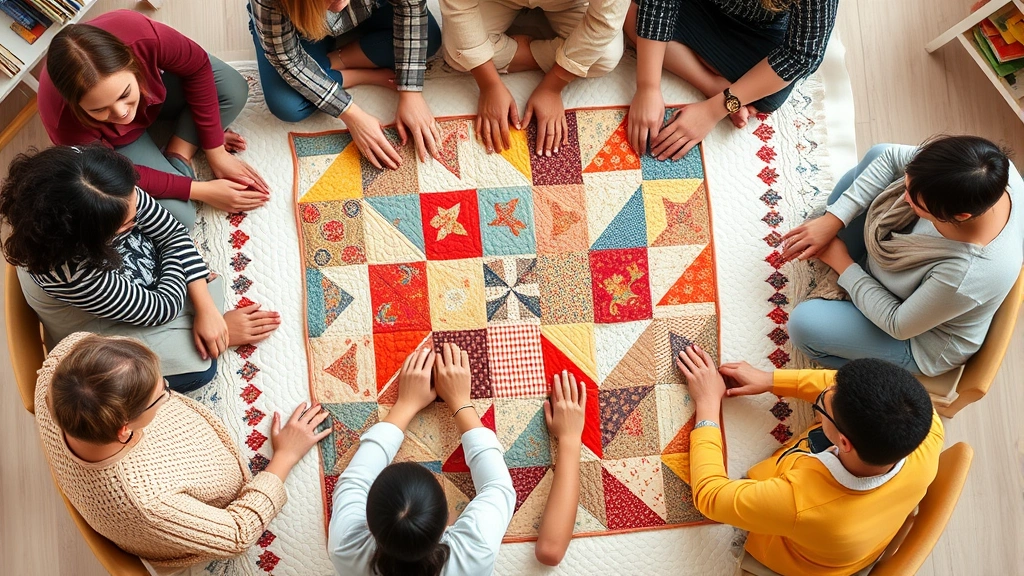
While the individual benefits of quilting are significant, the social dimensions deserve equal attention. Many of my patients come to therapy struggling with isolation, loneliness, and disconnection—conditions that have intensified post-pandemic. Quilting circles and community quilting projects address these relational wounds directly.
The quilting community is remarkably welcoming and intergenerational. Quilting circles bring together people across age groups, socioeconomic backgrounds, and life experiences. This diversity itself becomes therapeutic. A 28-year-old lawyer sitting beside a 78-year-old retired teacher, both focused on the same creative task, creates natural opportunities for connection that transcend the awkwardness of forced social interaction.
Furthermore, quilting circles embody what I call “side-by-side vulnerability.” Unlike face-to-face conversation, which can feel intensely exposing for trauma survivors or socially anxious individuals, quilting allows meaningful connection to develop while attention is partially directed toward the craft. This reduces the pressure of sustained eye contact and creates natural pauses in conversation.
Many quilting circles also engage in purpose-driven projects—creating quilts for hospital patients, homeless shelters, or families experiencing loss. This service orientation activates what researchers call the “helper’s high,” a neurochemical reward response triggered by altruistic action. I’ve observed that patients who participate in community quilting projects show significant improvements in purpose, meaning, and social connection—all protective factors against depression and anxiety.
Quilting as Mindfulness Practice
In my clinical training, I learned that mindfulness—present-moment awareness without judgment—is one of the most evidence-based interventions for mental health. However, I’ve discovered that traditional meditation proves challenging for many patients, particularly those with trauma histories or ADHD. Quilting offers an alternative pathway to mindfulness that feels more accessible and engaging.
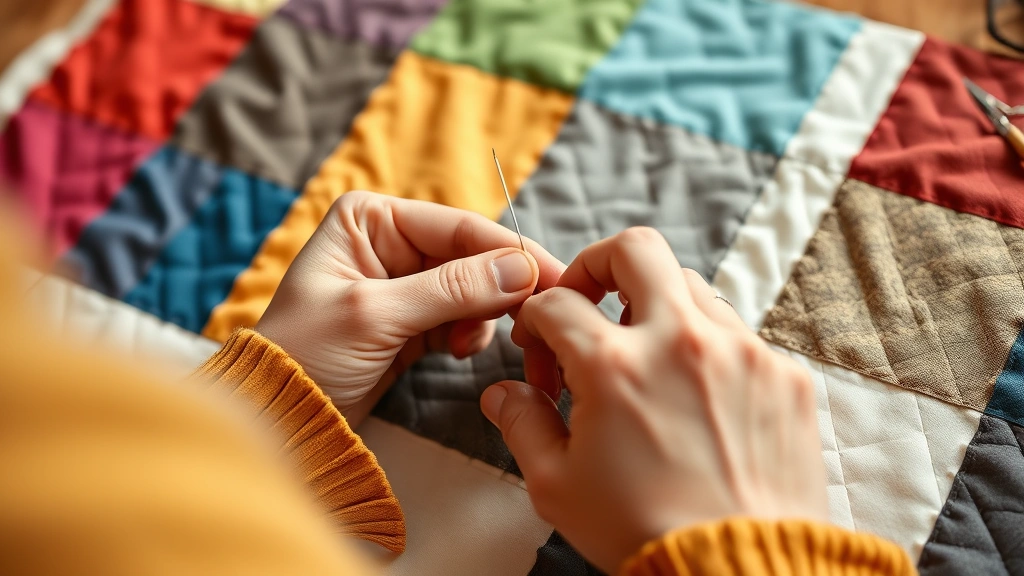
When properly approached, quilting becomes a form of moving meditation. The repetitive hand motions, the focus required to maintain consistent stitching, the visual attention to pattern and color—these elements naturally cultivate the present-moment awareness that defines mindfulness. Unlike sitting meditation, which asks the mind to observe thoughts without engagement, quilting gives the mind a purposeful task that prevents rumination while still allowing a meditative state.
The research supporting this is compelling. Studies published in the Nature journal demonstrate that engaging in creative crafts produces similar brainwave patterns to formal meditation practice. Participants showed increased alpha wave activity—associated with relaxation and creativity—and decreased beta wave activity—associated with stress and anxiety.
One patient, Sarah, who had experienced significant trauma and found traditional meditation retraumatizing, described quilting this way: “My therapist taught me mindfulness, but my body wouldn’t cooperate. When I started quilting, I discovered I could be present without forcing it. The quilt itself held my attention in a way that felt safe.” This distinction is clinically important: quilting provides mindfulness benefits without requiring the same degree of self-directed mental discipline that many traumatized individuals cannot yet access.
Overcoming Depression Through Creative Expression
Depression fundamentally alters motivation and pleasure capacity—what clinicians call anhedonia. Patients describe feeling disconnected from activities they once enjoyed, struggling to initiate any action, and experiencing a pervasive sense of meaninglessness. Traditional antidepressants and therapy help, but many patients benefit from structured creative engagement that reconnects them with agency and accomplishment.
Quilting addresses depression through multiple pathways. First, it combats the motivational deficit by breaking large projects into manageable steps. Rather than facing the overwhelming prospect of “make a quilt,” patients work on one block, one seam, one row at a time. This scaffolded approach aligns with what I teach regarding therapy and wellness resources—depression thrives when we perceive tasks as insurmountable, but dissolves when we focus on concrete, achievable actions.
Second, quilting directly engages the brain’s reward system. Completing even small segments of a quilt triggers dopamine release—the same neurochemical implicated in motivation and pleasure. Over time, this repeated activation of the reward system begins to counteract depressive numbness. One patient described the moment she finished her first quilt block: “I felt something. For the first time in months, I felt genuinely proud of something I made. It sounds small, but it wasn’t.”
Third, quilting creates what I call “evidence of worth.” Depression whispers lies about our value and capability. A completed quilt—something objectively beautiful and functional that required skill, persistence, and care—contradicts these depressive narratives. It becomes physical proof that the person is capable, creative, and worthy.
I particularly recommend quilting to patients with treatment-resistant depression or those who experience depressive episodes seasonally. The project-based nature means patients can work on quilts during depressive periods, gradually building momentum and evidence of capability that supports recovery.
” alt=”Hands stitching colorful fabric pieces together at a quilting frame with natural light”>
Integrating Quilting with Traditional Therapy
While quilting offers significant therapeutic benefits independently, I’ve found that integrating it with traditional therapeutic approaches amplifies results. In my practice, I recommend quilting as a complement to evidence-based treatments, not a replacement.
For patients undergoing cognitive-behavioral therapy, quilting serves as an experiential laboratory for practicing new skills. A patient learning to tolerate uncertainty might work on a complex pattern where mistakes become part of the design. A patient practicing self-compassion might choose to accept imperfect stitches rather than unpicking and redoing work. These lived experiences of tolerating imperfection, managing complexity, and practicing self-acceptance translate directly into therapeutic gains.
For trauma survivors, quilting can facilitate processing in ways that talk therapy alone sometimes cannot. The sensory engagement, the sense of control, and the creative expression all support trauma integration. However, I’m careful to recommend quilting only when the patient has sufficient nervous system stability. Too early in trauma recovery, the inward focus required by quilting might intensify dissociation or triggering.
Additionally, I integrate quilting with mindfulness-based stress reduction, particularly for patients with chronic pain or illness. The focus required by quilting redirects attention away from physical discomfort while providing the mental health benefits of creative engagement. I’ve worked with occupational therapy professionals to adapt quilting projects for patients with physical limitations, ensuring accessibility across ability levels.
For patients exploring attachment patterns and relational healing, quilting circles provide safe spaces to practice connection. I sometimes assign quilting projects that involve collaboration or gift-giving, creating opportunities to practice vulnerability and interdependence in structured, manageable ways.
The integration approach also addresses potential limitations of quilting alone. Some patients might use quilting to avoid processing difficult emotions rather than to facilitate processing. My role is to help patients distinguish between healthy engagement with quilting and avoidant use of the craft as escape.
FAQ
Is quilting effective for severe mental illness like bipolar disorder?
Quilting can be beneficial for individuals with bipolar disorder, particularly during stable phases. During manic episodes, the stimulating nature of quilting might require monitoring. I recommend quilting as a complementary practice alongside psychiatric medication and therapy, not as a standalone treatment for severe mental illness.
Do I need to be skilled at quilting for it to be therapeutic?
Absolutely not. In fact, the therapeutic benefits often increase when individuals release perfectionism and embrace the learning process. Many of my patients found that their initial imperfect quilts became the most meaningful—they represented courage to try something new despite fear of failure.
How long before I notice mental health improvements from quilting?
Many patients report immediate stress-reduction benefits—even during the first quilting session. However, the deeper impacts on mood, anxiety patterns, and self-worth typically emerge over weeks to months of consistent practice. I generally recommend committing to at least 4-8 weeks of regular quilting before assessing its impact on your mental health.
Can quilting replace therapy or medication?
No. Quilting is a powerful complementary tool, but it should not replace evidence-based mental health treatment. If you’re experiencing significant depression, anxiety, or other mental health challenges, seek professional help. Quilting works best as part of a comprehensive treatment approach that might include therapy, medication, lifestyle changes, and creative practices.
Where can I find quilting communities or classes?
Local quilt shops, community centers, libraries, and adult education programs typically offer quilting classes. Online communities and virtual quilting circles have also expanded accessibility. Many quilting circles specifically focus on therapeutic or community-building aspects, not just technical skill development.
What if I have physical limitations that make quilting difficult?
Occupational therapists, including those in occupational therapy professions, can help adapt quilting projects for various physical limitations. Large-print patterns, ergonomic tools, machine quilting, and shorter sessions are all modifications that preserve the therapeutic benefits while accommodating physical needs.